

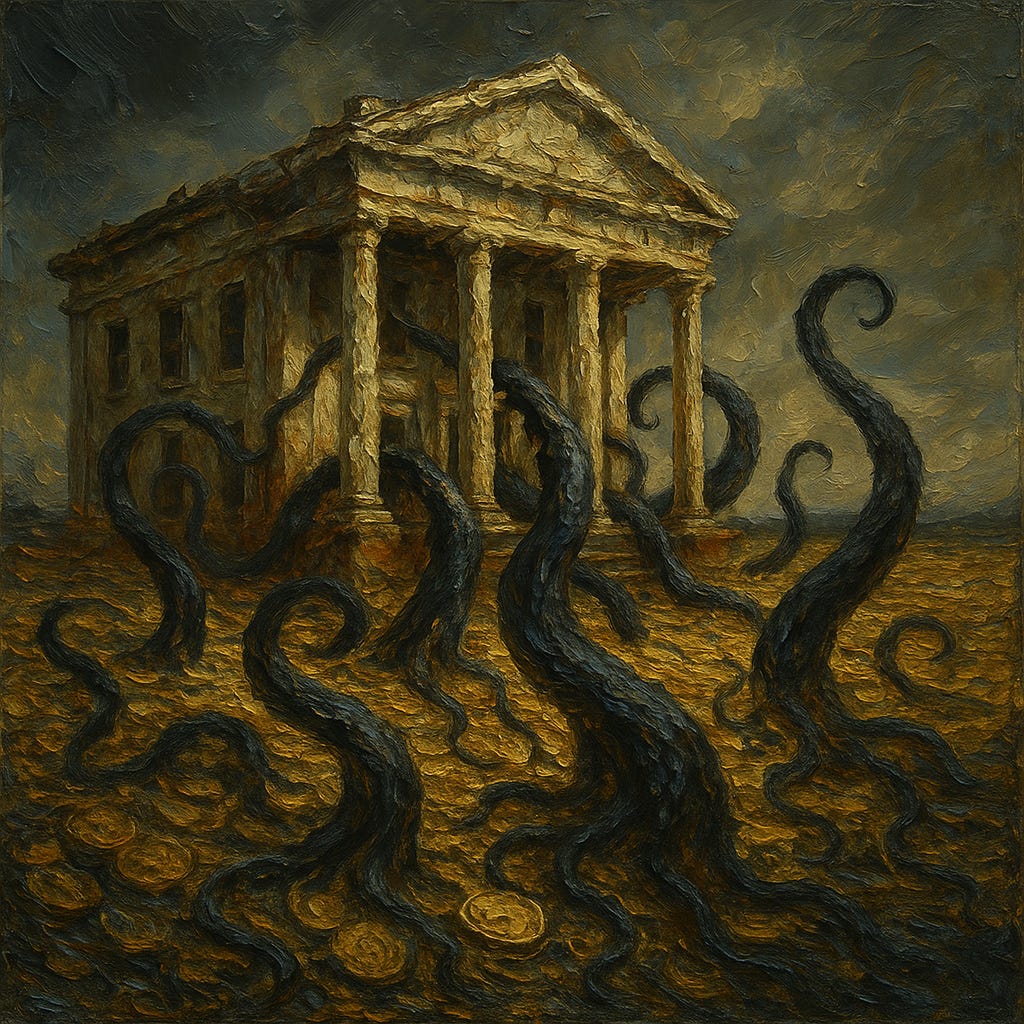
I came across Richard C. Cook’s work as a consequence of my own research into central banking—a subject I’ve written extensively about and one that continues to reveal deeper layers the further you dig. Cook’s perspective immediately stood out. Here was a former Treasury Department analyst and NASA whistleblower who had spent thirty-two years inside the federal government, watched the Challenger disaster unfold from the inside, and emerged with a view of American power that most officials take to their graves. What struck me was his willingness to connect dots that others leave scattered: the relationship between private banking and public policy, the thread running from Cecil Rhodes’s secret society to the Council on Foreign Relations, the way monetary control shapes everything from wars to recessions to the slow erosion of the middle class. Cook writes as a witness, not merely an analyst—his family’s story stretches back to Puritan Massachusetts, through the Civil War, the Oklahoma land runs, and Montana’s Flathead Reservation, giving him roots in the American experience that few historians can claim.
Our Country, Then and Now is not a comfortable book. It challenges foundational narratives about American democracy, argues that private financial interests captured the republic generations ago, and traces a line from the Federal Reserve’s creation through two world wars to the current proxy conflict in Ukraine. Cook names names—the Morgans, Rockefellers, Warburgs, and the institutional networks that connect Wall Street to Langley to the corridors of power in London. He examines how the “special relationship” between Britain and America emerged not from shared democratic values but from shared financial interests, how the national security state functions as an enforcement arm for those interests, and how each generation’s crises—from the Great Depression to 2008 to COVID—have enriched the few while impoverishing the many.
What makes Cook’s account distinctive is its personal dimension. His ancestors fought in the Revolutionary War, the War of 1812, the Civil War, and both World Wars. His great-grandfather participated in the Oklahoma land runs and learned the Shawnee language while running a grocery store in Indian Territory. His father trained at Camp Peary before it became the CIA’s “Farm.” Cook himself worked at the Carter White House and spent years at Treasury studying the very monetary system he now critiques. This is not detached academic history but a reckoning with inheritance—both the promises America made to its people and the betrayals that followed.
Whether you accept every conclusion or not, the evidence Cook marshals demands serious engagement. At a moment when trust in institutions has collapsed and Americans across the political spectrum sense that something has gone fundamentally wrong, he offers a framework for understanding how we arrived here—and, in his appendix on monetary reform, a path toward something different. I’m honored to present this educational exploration of Richard C. Cook’s Our Country, Then and Now, a book that deserves far wider attention than it has received. You can find more of Cook’s writings at ScheerPost and through the American Monetary Institute, where his work on the NEED Act continues the tradition of Lincoln’s Greenbacks—sovereign money for sovereign people.
With thanks to Richard Cook.
Our Country, Then and Now: Cook, Richard C.
This deep dive is based on the book:
Insights and reflections from “Our Country, Then and Now”
Thank you for your support.
Imagine a household where the family does not control its own checkbook. Instead, a private financial manager holds the checkbook and decides how much money the family can access each month. Every time the family needs funds—for groceries, for home repairs, for the children’s education—they must borrow from this manager, who charges interest on every loan. The family works hard, earns income, but that income flows first to the manager, who takes his cut before allowing the family their share. Over generations, the family sinks deeper into debt to the manager, even as they produce more and work longer hours. The manager, meanwhile, grows wealthy from the interest payments. He uses that wealth to influence the family’s decisions: which jobs they take, which purchases they make, which neighbors they befriend or shun. The family believes they are making free choices, but the manager’s control over their finances shapes every option available to them. This is the American monetary system. The Federal Reserve is the manager; the American people are the family; and the debt that compounds year after year is the chain that binds productive labor to financial extraction.
The United States was founded with genuine aspirations toward self-governance and human liberty, but from the very beginning, financial interests worked to capture the machinery of government for their own enrichment. The struggle between productive citizens and financial predators runs through every era of American history—from Hamilton’s bank to Jackson’s war against the Second Bank, from Lincoln’s Greenbacks to the “Crime of 1873,” from the Jekyll Island conspiracy to the endless bailouts of our own time. The Federal Reserve, created in 1913 through secret meetings of bankers, transferred control over the nation’s money from Congress to private interests. This financial power merged with British imperial ambitions through the “special relationship” forged after McKinley’s assassination, creating an Anglo-American establishment that has pursued global dominance through two world wars, the Cold War, and the current confrontations with Russia and China. The national security state—the CIA, NSA, Pentagon, and their contractor networks—enforces this financial empire while the mainstream media manufactures consent. We live in a Rockefeller Republic where elections change personnel but not policy, where the Deep State pursues its agenda regardless of public opposition, and where the chains of debt bind every citizen from birth to death.
[Elevator dings]
For further research: examine the monetary reform proposals of the American Monetary Institute, the history of the Council on Foreign Relations as documented by Carroll Quigley, and the independent investigations into September 11 compiled by the International Center for 9/11 Justice.
1. Religious persecution drove early American settlement. The Puritan migration established communities of self-reliant artisans and farmers escaping persecution by the Church of England. These settlers brought aspirations for religious freedom and local self-governance that would shape American ideals, even as their arrival initiated catastrophic demographic collapse among Native American populations through disease, displacement, and violence.
2. The Constitution left dangerous gaps in monetary authority. The founders failed to clearly establish how money would be created and controlled, leaving the door open for private banking interests to fill the vacuum. From Hamilton’s assumption of war debts at full face value to speculators onward, financial elites maneuvered to profit from public necessity while ordinary citizens bore the costs.
3. Territorial expansion served financial as much as ideological purposes. “Manifest Destiny” provided religious rhetoric for what was essentially Lebensraum—the seizure of continental resources from indigenous peoples and competing European powers. The Louisiana Purchase demonstrated how private British banking interests (Barings Bank) financed American expansion while positioning themselves to profit from the new nation’s growth.
4. The Civil War produced Lincoln’s Greenbacks—government-issued currency. Refusing usurious terms from private bankers, Lincoln’s Treasury printed money directly, demonstrating that government possesses sovereign power to create currency for public purposes without incurring debt to private interests. This principle, suppressed after the war, remains the foundation for genuine monetary reform.
5. The “Crime of 1873” and gold standard served international finance. Demonetization of silver produced decades of deflation that enriched creditors—especially the Rothschilds, Morgans, and associated banking interests—while impoverishing farmers and working people. The gold standard concentrated monetary control in the hands of those who controlled gold, primarily the mining operations of Cecil Rhodes in South Africa.
6. The Federal Reserve transferred monetary sovereignty to private bankers. Created through secret planning at Jekyll Island in 1910, the Federal Reserve System gave private banking interests control over currency creation, interest rates, and economic expansion or contraction. The institution that claimed to prevent financial panics instead triggered the Great Depression and has presided over continuous currency devaluation ever since.
7. Cecil Rhodes and British imperial interests aimed to “recover America for the Empire.” Rhodes’s secret society, continued through the Round Table movement, the Royal Institute of International Affairs, and the Council on Foreign Relations, worked to bind American power to British strategic objectives. The “special relationship” that emerged after McKinley’s assassination subordinated American foreign policy to Anglo-American financial elite interests.
8. World War II established permanent American global military dominance. The Council on Foreign Relations, funded by Morgan and Rockefeller interests, advised Roosevelt to use the war as a springboard for American world power. The national security state created in 1947—the CIA, NSC, and their successors—became instruments for enforcing financial hegemony through covert operations, assassinations, coups, and propaganda.
9. The petrodollar system anchors American global power. After Nixon abandoned gold convertibility in 1971, the arrangement requiring oil to be priced exclusively in dollars created permanent global demand for American currency. This enables the United States to run perpetual deficits while maintaining dollar value, but requires military enforcement against any nation—Iraq, Libya, Iran—that threatens de-dollarization.
10. The Wolfowitz Doctrine codified permanent hegemony. The 1992 document stated explicitly that America must prevent any potential competitor “from even aspiring to a larger regional or global role.” This vision—unchanged from the Council on Foreign Relations’ wartime planning—has driven NATO expansion, regime change operations, and the current confrontations with Russia and China.
11. September 11 enabled the “War on Terror” that neoconservatives had planned. Whether through incompetence, foreknowledge, or active participation, the attacks provided exactly the “new Pearl Harbor” that the Project for the New American Century had specified as necessary for American military transformation. The resulting wars, surveillance systems, and concentration of executive power advanced objectives predating the attacks.
12. The financial system continues to extract wealth from productive citizens. Fractional reserve banking, compound interest, derivatives speculation, and Federal Reserve manipulation transfer resources from those who work to those who lend. Each crisis—1929, 2008, 2020—enriches bankers through bailouts while ordinary people lose jobs, homes, and savings. The NEED Act offers a path toward sovereign money creation for public benefit, but implementation requires breaking the political power of the financial elite.
The most profound idea in this book—the one that fewest people understand—is that private control of money creation is the root mechanism by which democracy is subverted and populations are enslaved.
Every dollar in circulation comes into existence as debt owed to private banks. The Federal Reserve does not print money and hand it to the government; it creates money by lending it into existence, with interest. Commercial banks multiply this process through fractional reserve lending, creating additional money as loans while holding only a fraction in reserve. Every mortgage, every car loan, every credit card balance, every government bond represents money that must be repaid with interest—interest that can only come from money that must itself be borrowed into existence. The system requires perpetual growth of debt merely to pay interest on existing debt. This is not an accident or an oversight; it is the designed mechanism by which wealth flows from those who produce to those who lend.
When Lincoln printed Greenbacks to fight the Civil War, he demonstrated that government can create money directly for public purposes without incurring debt to private bankers. This is what the Constitution intended: Congress shall have power “to coin money, regulate the value thereof.” Instead, Congress surrendered this power to the Federal Reserve in 1913. Since then, every economic decision—every war, every social program, every infrastructure project—has been financed through borrowing from the private banking system. The national debt is not a bug in the system; it is the system working as designed. The interest payments flow to bondholders; the principal is rolled over into new debt; the debt compounds generation after generation.
Those who control money creation control everything. They can expand credit to fuel booms and contract it to produce busts, enriching themselves through foreknowledge of both. They can fund wars or deny funding; they can inflate currencies to erode savings or deflate them to favor creditors. They can purchase politicians, media organizations, universities, and think tanks. They can make or break governments. The Federal Reserve, the Bank of England, the European Central Bank—these are not public institutions serving the common good but private consortiums serving their owners.
This is why monetary reform is not merely one issue among many but the central issue from which all others flow. Until the sovereign power to create money is restored to democratic government and exercised for public benefit rather than private profit, no lasting reform of any other problem—inequality, war, environmental destruction, political corruption—is possible. The chains of debt bind every citizen; only by understanding those chains can we hope to break them.
Question 1: What motivated the Puritan migration to America, and how does the Bliss family’s experience illustrate the religious persecution that drove early settlers to the New World?
The Puritan migration to America grew from systematic persecution by the Church of England and the Stuart monarchy. Religious dissenters faced fines, imprisonment, property seizure, and physical violence for their nonconformity. Thomas Bliss of Devonshire, a wealthy landowner, was “maltreated, impoverished, and imprisoned” under Archbishop Laud’s direction. His sons Jonathan and Thomas were fined a thousand pounds, thrown into prison, and led through the marketplace with ropes around their necks. Jonathan suffered thirty-five lashes with a three-corded whip at Exeter, injuries that eventually caused his death. The family’s cattle, horses, sheep, and cherished household furniture—items that “had been in the family for centuries”—were seized by crown officers. Only one poor ewe escaped by running into the house and hiding under a bed.
After Thomas Bliss Sr. and Jonathan died from their maltreatment, the surviving son Thomas emigrated to Massachusetts in 1636. He arrived in New England and settled first near Boston Bay, then moved to Rehoboth (originally called Seekonk) in 1643. Unlike the French and Spanish, the English settled America through private initiatives rather than government-directed expeditions. Thomas Bliss worked as a blacksmith, an artisan of the local economy and his own boss. He owned his home, ran his own business, took part in local government, and bequeathed items of value to his children. He appears to have had no debt. This pattern of self-reliant settlers escaping persecution and building independent lives represents one strand of the American founding—though it would exist in tension with other forces, particularly the financiers and slaveholders, whose influence grew over subsequent centuries.
Question 2: How did European contact affect Native American populations, and what patterns of disease, displacement, and treaty violation characterized relations between settlers and indigenous peoples?
The arrival of Europeans initiated what has been called the greatest demographic disaster in known history. Around 1600, the present continental United States had a native population of at least fifteen million—nearly four times the population of England at that time. By 1900, three centuries later, only about 250,000 full-blooded Native Americans remained. The recurring pattern began with devastating pandemics—smallpox, plague, influenza, malaria, and measles—transmitted through contact with Europeans who then appeared in larger numbers once disease had weakened native resistance. In the 1780s, a smallpox outbreak reached the Salish people near present-day Missoula, killing an estimated one-half to three-quarters of their bands. This collapse of living standards due to white aggression, poverty, and war compounded the effects of disease, reducing once-thriving civilizations to remnant populations.
The political and legal framework systematically dispossessed surviving Indians. Chief Justice John Marshall’s 1823 decision defined the “right of discovery” as giving Europeans “an exclusive right to extinguish the Indian title of occupancy, either by purchase or by conquest.” An 1831 decision held that Indian tribes were “domestic dependent nations” without inherent rights to sovereignty and self-determination. Treaties were signed, then violated when whites coveted Indian lands. The Cherokee Trail of Tears, the Seminole wars, the battles in the Ohio Valley, and the Plains Indian wars all followed this pattern. Even well-intentioned reforms proved destructive: the Dawes Act of 1887 divided communal reservation lands into individual allotments, opening “surplus” land to white settlement and destroying the economic base of tribal life. Federal policy oscillated between extermination and forced assimilation, but the underlying constant was dispossession driven by white demand for land, minerals, and timber.
Question 3: What were the competing visions for America’s financial system at the nation’s founding, and how did conflicts between agrarian and banking interests shape early monetary policy?
The Constitution left enormous gaps regarding money and banking that would generate conflict for the next two centuries. Article I granted Congress power “to coin money, regulate the value thereof,” but said nothing about paper money or commercial banking. The scarcity of gold and silver limited circulating coinage and constrained commerce in a developing economy. Alexander Hamilton, the first Secretary of the Treasury, aligned with merchants, investors, and speculators—including wealthy Europeans—who had financed the Revolutionary War through bonds. Hamilton arranged for the federal government to pay all war debt at full face value, a decision that enriched speculators who had bought up promissory notes from soldiers at steep discounts. This set the pattern of government policy favoring financial interests over common citizens.
Thomas Jefferson and the agrarian faction represented a different vision, suspicious of banking power and concentrated wealth. Andrew Jackson later declared war on the Second Bank of the United States, viewing it as an instrument of British and Eastern financial interests hostile to farmers and working people. The fundamental tension persisted: would money creation serve productive enterprise and the general welfare, or would it enrich bankers through usurious lending? Fractional reserve banking—where banks lend far more than they hold in deposits—had been institutionalized in Europe since the Middle Ages, allowing financiers to multiply the money supply and charge compound interest on loans created from nothing. This system migrated to America despite its obvious potential for inflation, crashes, and favoritism. The Constitution’s vagueness, combined with the political power of the financier class, ensured that these questions would remain contested—and that bankers would generally prevail.
Question 4: How did the Louisiana Purchase exemplify the relationship between territorial expansion and private banking, particularly the role of British financial institutions?
When Thomas Jefferson negotiated the Louisiana Purchase in 1803, the transaction revealed how thoroughly private banking interests—especially British ones—were embedded in American affairs. France agreed to sell the territory for $15 million: $2 million in gold, $11.25 million in 15-year bonds at six percent interest, and $1.75 million in short-term promissory notes. Napoleon, seeing no merit in holding bonds from a “barely reputable republic,” immediately sold them at a discount of $87.50 on the hundred to Alexander Baring of the British Barings Bank. The United States effectively bought the Louisiana territory from Barings Bank, not from the French government. This transaction established a recurring pattern of financial sleight-of-hand involving the U.S. government and private bankers, especially British ones.
Jefferson had no constitutional qualms about the purchase—those complaints came from Federalist opponents who blocked anything he attempted. His real concern was money. When he became president in 1801, the government was worse than penniless, carrying $83 million in debt with ninety percent of the budget going to military spending and interest payments. Yet Jefferson had long coveted the western territory for future American expansion and was certain the rate of return on his $15 million investment would justify the borrowing. He was right about the territorial value but perhaps failed to anticipate how deeply the transaction bound American expansion to British financial power. Any type of government borrowing is a mortgage against the nation’s future, and this mortgage would compound over generations as American territorial growth and British banking influence advanced together.
Question 5: What was the origin and meaning of “Manifest Destiny,” and how did this ideology justify territorial expansion and the displacement of Native Americans?
The phrase “Manifest Destiny” originated not from theological doctrine or constitutional principle but from newspaper propaganda. In 1839, journalist John L. O’Sullivan predicted a “divine destiny” for the United States based on values like equality and individual rights, claiming America was preordained “to establish on earth the moral dignity and salvation of man.” Six years later, urging annexation of Texas, O’Sullivan wrote that it was “our manifest destiny to overspread the continent allotted by Providence for the free development of our yearly multiplying millions.” He invoked Providence again regarding Oregon: Americans possessed “the right of our manifest destiny to overspread and to possess the whole of the continent which Providence has given us.” This was essentially Lebensraum—elbow room—dressed in religious language, a media pronouncement elevated to national mission.
The ideology served to justify what was already occurring through force. Andrew Jackson spoke of “extending the area of freedom” while removing Indians from the Southeast and working his own enslaved people on his plantation. Freedom for whom? The Whigs correctly identified such rhetoric as “treason to our Constitution and Declaration of Rights” and “preaching the doctrine of the right of conquest.” But this right of conquest, as Chief Justice Marshall had already affirmed, was the principle by which Europeans and Americans had been disenfranchising Native Americans for centuries. Mississippi Representative Reuben Davis extended the logic to its conclusion in 1859: “We may expand so as to include the whole world.” The phrase “Manifest Destiny” faded from use, but the underlying attitude of American exceptionalism and entitlement to global dominance persisted. It finds expression today in assertions that the United States is the “exceptional” or “indispensable” nation, entitled to impose its will worldwide.
Question 6: How did the “right of discovery” and “right of conquest” doctrines, as articulated by Chief Justice John Marshall, provide legal framework for American treatment of indigenous peoples?
Chief Justice John Marshall’s decisions in the 1820s and 1830s codified into American law the principles that would govern Indian policy for over a century. In 1823, Marshall defined how the “right of discovery” related to the “right of conquest”: “The United States...have unequivocally acceded to that great and broad rule by which its civilized inhabitants now hold this country. They hold, and assert in themselves, the title by which it was acquired. They maintain, as all others have maintained, that discovery gave an exclusive right to extinguish the Indian title of occupancy, either by purchase or by conquest.” This doctrine traced authority to the British crown, which had passed to the United States through independence. No presumption of divine right was necessary—under republican government, such a right was simply proclaimed.
An 1831 decision extended the framework by declaring Indian tribes “domestic dependent nations” without inherent rights to sovereignty and self-determination. This doctrine ruled U.S. Indian policy until limited sovereignty was acknowledged for federally recognized tribes in 1935. Marshall’s formulation was hubris of the kind the Greeks considered a fatal flaw. The concept of “right of conquest” essentially dared anyone to challenge American possession. Such arrogance, visible in American policy from the Indian wars through contemporary foreign interventions, cannot go unpunished by the principle expressed across civilizations: “Do not be deceived: God is not mocked, for whatever one sows, that will he also reap.” The legal architecture Marshall constructed enabled treaty violations, forced removals, allotment schemes, and cultural destruction to proceed under cover of law rather than naked force—though force was always the underlying reality.
Question 7: What role did monetary policy—particularly the conflict between gold and silver standards—play in 19th century American politics and economic development?
The question of what would back American currency—gold, silver, or government-issued paper—generated fierce political conflict throughout the 19th century. Gold was scarce and favored creditors, bankers, and those with accumulated wealth; it produced deflation that increased the real burden of debt on farmers and working people. Silver was more abundant and favored debtors who wanted easier money and rising prices. The Constitution established a value ratio between gold and silver of 15:1, but this coinage proved inadequate for a growing economy. The Coinage Act of 1837 attempted to balance silver and gold, but successive laws tilted toward gold. The “Crime of 1873” discontinued production of the U.S. silver dollar, a measure promoted by wealthy bankers—especially J.P. Morgan, Jacob Schiff, and the Rothschilds—who profited from deflation and the gold standard.
Price deflation following 1873 pushed farmers and debtors toward the “free silver” movement, demanding unlimited coinage of silver dollars as legal tender. The Bland-Allison Act of 1878 restored silver as legal tender and directed Treasury to purchase silver bullion, but fell short of free silver demands. William Jennings Bryan’s 1896 “Cross of Gold” speech made free silver the Democratic platform, but his defeat—combined with new gold discoveries in South Africa and the Yukon—ended silver agitation as a political threat. Gold reigned supreme, to the delight of international finance and Great Britain, whose government the Rothschilds controlled. South African gold, exploited mainly by Cecil Rhodes and the Rothschilds, constituted half the world’s production and propelled Great Britain to world dominance. The central financial problem remained unsolved: no government had created a reliable circulating medium that was neither inflationary nor deflationary and fair to all social classes.
Question 8: How did the Civil War transform the American financial system, and what was the significance of the Greenbacks as government-issued currency?
The Civil War forced the federal government into monetary innovation that briefly challenged banker control of the money supply. With war expenditures dwarfing available revenues, the Lincoln administration faced a choice: borrow from private banks at usurious rates or create government-issued currency. Treasury Secretary Salmon P. Chase initially approached New York bankers, who demanded interest rates of 24 to 36 percent. Lincoln rejected these terms and authorized the printing of “Greenbacks”—U.S. Notes issued directly by the Treasury, backed by the full faith and credit of the government rather than gold or bank reserves. Between 1862 and 1865, approximately $450 million in Greenbacks entered circulation, financing the Union war effort without incurring interest payments to private bankers.
The Greenbacks demonstrated that government could create its own currency to fund public purposes—a principle the banking establishment found threatening. After the war, bankers pushed to retire the Greenbacks and restore a gold-backed, bank-controlled monetary system. The Specie Payment Resumption Act of 1875 required Treasury to redeem outstanding Greenbacks in gold. Yet when redemption day arrived, few people actually exchanged their Greenbacks—only $130,000 of the outstanding $346 million was redeemed. Public confidence in Lincoln’s “people’s money” remained strong, and Greenbacks continued circulating into the 20th century. The Greenback Party, active from 1874 to 1889, ran presidential candidates on a platform of government-issued currency, but third parties struggle to sustain momentum. The principle survived in memory: government possesses the sovereign power to create money for public benefit without enriching private bankers through interest on debt.
Question 9: What was the “Crime of 1873,” and how did the demonetization of silver affect farmers, debtors, and the broader American economy?
The Coinage Act of 1873 discontinued the standard silver dollar and placed the United States on a de facto gold standard. Silver advocates labeled this the “Crime of 1873,” charging that banking interests had secretly maneuvered to remove silver from the monetary system to produce deflation that would benefit creditors at the expense of debtors. The measure was promoted most strongly by wealthy bankers and financiers—J.P. Morgan and Jacob Schiff in the United States, along with the Rothschilds, Barings, and other British and European financial magnates abroad. By limiting the money supply to gold, which was scarce and controlled by a small number of powerful interests, the Act ensured that prices would fall and the real burden of debt would increase.
The consequences fell heavily on farmers, who borrowed to plant crops and repaid loans with dollars worth more than those they had borrowed. Agricultural prices collapsed while debts remained fixed, driving farmers into bankruptcy and tenancy. The deflation persisted for decades, fueling agrarian revolt through the Greenback Party, the Farmers’ Alliance, and eventually the Populist movement. William Jennings Bryan’s 1896 campaign channeled this anger with his declaration that mankind should not be crucified “upon a cross of gold.” Bryan lost, and new gold discoveries eased the deflation, but the underlying dynamic remained: a monetary system controlled by private bankers inevitably tilts wealth toward lenders at the expense of everyone else. The “Crime of 1873” demonstrated how seemingly technical legislation about coinage could transfer billions from working people to the financial elite.
Question 10: How did the “Money Trust”—the alliance of Morgan, Rockefeller, and associated banking interests—consolidate control over American finance during the Gilded Age?
By the late 19th century, two interconnected financial empires dominated American economic life. The Rockefeller group centered on the Standard Oil fortune, which had diversified into railroads, chemicals, mining, insurance, utilities, medicine, and banking—particularly the National City Bank that would become Citigroup. The Rockefellers cemented their political influence through marriage: Abigail Aldrich, daughter of Senator Nelson Aldrich of Rhode Island, married John D. Rockefeller Jr., uniting the greatest industrial fortune with one of the Senate’s most powerful figures. The Morgan group, the “inner circle” of the Money Trust, included Great Northern Railway CEO James Hill and George Baker of First National Bank. James Stillman of National City Bank straddled both empires, linking Rockefeller and Morgan interests.
These Money Trusts were progenitors of what economists today call the FIRE economy—finance, insurance, and real estate. Their rise marked a fundamental shift from earning money through industrial production to making money for its own sake through fractional reserve banking and usurious compound interest. The most successful application of antitrust law, the 1911 breakup of Standard Oil, did little to slow Rockefeller money-making; the family had already leveraged petroleum profits to diversify into every major economic sector. J.P. Morgan played a central role in the transition of financial power from Great Britain to the United States, bailing out Barings Bank in the 1890s and selling British government bonds to American investors for the Boer War. By the early 20th century, the financiers had become the most powerful political group in the country, controlling newspapers and magazines, purchasing politicians, and positioning themselves to seize control of the nation’s monetary system.
Question 11: What was Cecil Rhodes’s vision for British imperial expansion, and how did his “Confession of Faith” and secret society aim to influence global affairs, including “recovering America for the Empire”?
Cecil Rhodes articulated his vision for world dominance in an 1877 document he called his “Confession of Faith.” The diamond and gold magnate, backed by Nathaniel Rothschild’s financing, wrote: “I contend that we are the finest race in the world and that the more of the world we inhabit the better it is for the human race.” He argued that if Britain had “retained America there would at this moment be millions more of English living” and that “the absorption of the greater portion of the world under our rule simply means the end of all wars.” Rhodes proposed forming a secret society to achieve these aims, modeled on the Jesuits, with an inner circle and outer rings of influence extending throughout the English-speaking world.
Rhodes died in 1902, but his vision persisted through institutions he helped create. Alfred Lord Milner, who administered the former Boer republics after the war Rhodes helped instigate, recruited “Milner’s Kindergarten”—young Oxford graduates who formed the core of Rhodes’s secret society. This network evolved into the Round Table movement, which spawned the Royal Institute of International Affairs in Britain and influenced creation of the Council on Foreign Relations in the United States. The goal of “recovering America for the Empire” would not be achieved through reconquest but through financial and institutional integration—binding American and British elites together in pursuit of shared imperial objectives. According to historian Carroll Quigley, these organizations constituted “the Anglo-American Establishment” that has shaped Western foreign policy for over a century. Rhodes’s dreams of Anglo-Saxon world dominance found expression not in formal empire but in the “special relationship” that subordinated American power to British strategic objectives.
Question 12: How did the assassination of President William McKinley mark a turning point in American foreign policy toward alignment with British imperial interests?
William McKinley represented the tradition of American economic nationalism—high tariffs to protect domestic manufacturing, suspicion of British free-trade ideology, and foreign policy independence from European entanglements. McKinley’s 1890 Tariff Act aimed to “preserve the home market...to our own producers” and “render to labor in every field of useful occupation the liberal wages and adequate rewards to which skill and industry are justly entitled.” The tariff, McKinley declared, “had no friends in Europe.” His assassination in September 1901 by Leon Czolgosz, a disciple of Emma Goldman, brought Theodore Roosevelt to the presidency. Goldman’s headquarters was the Henry Street Settlement House in New York, built by Wall Street banker Jacob Schiff, who later financed Trotsky’s transport to Russia for the Bolshevik Revolution. The connections between anarchist violence and international finance remain murky but suggestive.
Theodore Roosevelt’s presidency marked a 180-degree turn in American foreign policy regarding Great Britain. Historians broadly agree that Roosevelt “believed absolutely in the doctrine of peace through strength” with “the United States and Great Britain as the two most righteous nations.” Roosevelt “cultivated and solidified the Anglo-American rapprochement,” with one scholar calling this developing bond “the foundation of Roosevelt’s foreign policy.” His “sense of a common task of Britain and America in ruling ‘colonial peoples’” provided the basis for cooperation. The era of independent American foreign policy—beginning with Washington’s warning against permanent alliances and Jefferson’s admonition against European entanglements—was now over. Nothing stood in the way of total control by the Anglo-American financial elite, followed by over a century of world war that has not yet ended. The assassination of three Republican nationalist presidents within thirty-five years—Lincoln, Garfield, and McKinley—cleared the path for this transformation.
Question 13: How was the Federal Reserve System created, what role did the Jekyll Island meeting play, and how did this represent a fundamental shift in control over American monetary policy?
The Federal Reserve emerged from a secret meeting at Jekyll Island, Georgia, in November 1910. Senator Nelson Aldrich—whose daughter had married John D. Rockefeller Jr.—convened representatives of the Morgan, Rockefeller, and Kuhn Loeb banking interests to draft legislation creating a central bank. Present were Aldrich, assistant treasury secretary A. Piatt Andrew, Morgan bankers Henry Davison and Arthur Shelton, Rockefeller’s National City Bank president Frank Vanderlip, and German émigré Paul Warburg of Kuhn Loeb, who had powerful Rothschild connections. The participants traveled under assumed names and maintained secrecy for years afterward. Their product, initially called the Federal Reserve Association, would give private bankers control over currency creation while providing a “lender of last resort” when speculation produced crashes.
The Federal Reserve Act passed Congress in December 1913 and represented surrender of Constitutional authority over the nation’s monetary system. Congress had the power “to coin money, regulate the value thereof,” but now delegated that power to a system of regional banks controlled by private banking interests. The Federal Reserve could expand or contract the money supply, set interest rates, and bail out banks that overextended through speculation. The Independent Treasury system, which had insulated the federal government from private banking instability, was dismantled. Government funds were transferred to Federal Reserve banks. The goal, as Aldrich and his collaborators conceived it, was to make New York the leading financial center in the world, operating on equal footing with the British pound. The British, for their own reasons involving recovery of American resources for imperial purposes, cooperated fully. Within four years, the new system would finance American entry into World War I alongside Great Britain.
Question 14: What factors drew the United States into World War I despite public opposition, and how did the war benefit American and British banking interests?
The American public opposed entry into the European war. President Woodrow Wilson won reelection in 1916 on the slogan “He kept us out of war.” Yet the entire financial and political establishment—especially the House of Morgan with its longstanding ties to British banks—worked to draw America into the conflict. Despite proclaimed neutrality, Wilson’s economic program benefited the Allies: a major tariff reduction made U.S. goods cheaper for British and French purchasers, while Morgan banks extended massive loans to the Allied powers. By 1917, the Allies owed American banks billions of dollars; if Britain and France lost, those loans would default. The sinking of the Lusitania, which carried munitions in its hold, provided propaganda for intervention, though three years passed before Wilson asked Congress to declare war.
The war proved enormously profitable for American banking and industry. The favorable U.S. balance of trade grew each year from 1914 to 1917, reaching over $3 billion. Unemployment disappeared as the gross national product increased by twenty percent. The world’s gold flowed to New York as Britain and France liquidated assets to pay for American supplies. By war’s end, the United States had transformed from a debtor nation into the world’s leading creditor, holding the largest gold stocks in history. The Federal Reserve, barely two years old when war began, demonstrated its utility in financing military expenditures and managing the transition to wartime economy. Financing the war cost ten times as much as the Civil War, but the costs were borne by taxpayers and inflation while the profits accrued to bankers and arms manufacturers. The Money Trust had achieved its objective: New York displaced London as the world’s financial center.
Question 15: How did the Council on Foreign Relations emerge, and what role has it played in shaping American foreign policy from World War I to the present?
The Council on Foreign Relations grew from joint meetings between British and American diplomats at the Hotel Majestic in Paris in May 1919, just before the signing of the Treaty of Versailles. While the British returned home to establish the Royal Institute of International Affairs—closely aligned with the Round Table movement descending from Cecil Rhodes—Americans created a parallel institution. Secret meetings in New York City, headed by Elihu Root (Theodore Roosevelt’s secretary of state), brought together 108 high-ranking officers of banking, manufacturing, trading, and finance companies, along with many lawyers. The Council on Foreign Relations was legally chartered on July 29, 1921. Its journal, Foreign Affairs, first published in 1922, was funded by “the thousand richest Americans.” The Rockefeller fortune has been instrumental in Council operations throughout its history.
The Council functions as the premier instrument of American international financial control, articulating elite consensus on foreign policy and supplying personnel to successive administrations. Within two weeks of Germany’s 1939 invasion of Poland, Council representatives met with the State Department to offer planning for postwar American dominance. Their War and Peace Studies project sent 682 memoranda to government policymakers, funded entirely by the Rockefeller Foundation. The CFR’s conclusion: the war was a “grand opportunity” for the United States to become “the premier power in the world.” Future CIA director Allen Dulles led the Armaments Group. This private organization, with no official government standing, defined America’s wartime objectives and postwar global posture. The pattern has continued: Council members populate every administration’s foreign policy apparatus, ensuring continuity of the globalist agenda regardless of which party holds power.
Question 16: What caused the Great Depression, and how did the interplay between the Federal Reserve, gold movements, and international banking contribute to the economic collapse?
The Great Depression resulted from deliberate decisions by central bankers rather than mysterious market forces. During the 1920s, gold flowed to the United States as European nations struggled with war debts and reconstruction, producing inflation in America and instability in Europe. In 1929, the heads of the Banks of England, France, and Germany demanded that the Federal Reserve raise interest rates to move gold back to Europe. According to one account, “the decision to do so was reportedly taken at a meeting over lunch.” The Federal Reserve complied, raising rates at precisely the wrong moment, sucking liquidity from the American economy. Smart money—those with insider knowledge—sold their stocks before the public realized what was happening. Then, crash. The movement of $500 million in gold to Europe “caused the deflation of the stock boom, the end of the business prosperity of the 1920s, and the Great Depression.”
The bankers knew what would happen and wanted the Depression because it put American business and finance “completely in their hands.” Germany was hit equally hard, with unemployment decimating the country and despair driving many to suicide or support for the Nazis. In the United States, the banking system collapsed altogether in February 1933, with runs draining gold reserves almost to the legal minimum. Franklin Roosevelt took office and immediately abandoned the gold standard, forbidding private holding of gold except for small amounts. The Federal Reserve pumped $200 million into the system through new loans to banks. The institution created to prevent panics had instead triggered the worst economic catastrophe in American history—then presented itself as the solution. The Depression demonstrated the catastrophic weakness of a bank-centered financial system, but reforms proved temporary. The pattern would repeat in 2008 and 2020.
Question 17: How did World War II serve as a springboard for establishing American global military dominance, and what was the Council on Foreign Relations’ role in planning postwar policy?
Even before Pearl Harbor, the Council on Foreign Relations was advising the Roosevelt administration to use the coming war as an opportunity for permanent global dominance. The CFR’s War and Peace Studies project, funded by the Rockefeller Foundation and led by future CIA director Allen Dulles, examined military expansion “no matter which way the European war went.” A debate emerged between those who believed America could secure only the Western Hemisphere and a more radical faction advocating total global military dominance. The radicals prevailed. By autumn 1940, the United States had begun its largest peacetime military buildup ever, including construction of the world’s largest navy—exceeding Britain’s. The first peacetime draft in American history ended unemployment. The government was preparing for a war the American public did not want.
A modern consensus holds that President Roosevelt deliberately provoked Japan to attack Pearl Harbor. Provocations included freezing Japanese assets in American banks, cutting Japan off from petroleum supplies through embargo, banning steel exports to Japan, and repeatedly sending warships into Japanese waters. A fourteen-part Japanese message decoded before the attack indicated war was imminent, yet Pacific commanders were not adequately warned. Roosevelt needed a spectacular attack to overcome public opposition to war. He got it. From that point forward, the Council on Foreign Relations’ vision guided American policy: total global military dominance, competition with the Soviet Union as a permanent enemy, and transformation of the United States into what President Eisenhower would later call the “military industrial complex.” The CFR had lobbied Roosevelt to adopt policies that would not merely defeat the Axis but set the stage for American control of the postwar world. Victory made that control possible.
Question 18: What were the origins and purposes of the CIA, and how has the agency functioned as an instrument of American financial and geopolitical interests?
The Central Intelligence Agency was created by the National Security Act of 1947, which also established the National Security Council and reorganized the military under the Department of Defense. The CIA’s stated purpose was intelligence gathering, but from the beginning its actual function extended far beyond analysis. The agency received authority for covert operations—secret wars, assassinations, coups, propaganda, and destabilization campaigns—that would be conducted without Congressional oversight or public knowledge. The wartime Office of Strategic Services provided personnel and institutional memory, but the CIA’s scope far exceeded anything previously attempted. Allen Dulles, who had led the Council on Foreign Relations’ wartime armaments study, became CIA director under Eisenhower and oversaw operations that toppled governments in Iran and Guatemala.
The CIA functions as the enforcement arm of American financial and corporate interests worldwide. Where governments resist American investment, the agency destabilizes them through propaganda, funded opposition movements, and outright coups. Where democratic elections produce unacceptable results, the agency intervenes. Operation Mockingbird infiltrated major news organizations with CIA assets who shaped coverage to support agency objectives. According to one estimate, at least 400 American journalists carried out assignments for the CIA over a 25-year period. The New York Times covertly employs numerous CIA operatives to this day. The agency also runs a massive drug trafficking operation, from the Golden Triangle to Latin America to Afghanistan, generating off-the-books funding for operations Congress would never approve. David Rockefeller, whose family was instrumental in creating the national security state, later acknowledged working toward “a more integrated global, political, and economic structure—one world, if you will.” The CIA has been the primary instrument for advancing that objective.
Question 19: How did the Rockefeller family’s influence extend across banking, intelligence, and foreign policy, creating what the author calls the “Rockefeller Republic”?
The Rockefeller dynasty exemplifies how concentrated wealth translates into political power across every domain. John D. Rockefeller’s Standard Oil fortune, despite the 1911 antitrust breakup, diversified into banking (National City Bank, later Citigroup, and Chase Manhattan), chemicals, mining, insurance, utilities, medicine, and real estate. The family’s political influence was cemented through Nelson Aldrich, the Senator whose daughter married John D. Rockefeller Jr. and who engineered creation of the Federal Reserve. David Rockefeller became head of Chase Manhattan Bank and, until his death at 101 in 2017, stood at the center of the global financial spider web. His brother Nelson served as governor of New York and vice president under Gerald Ford; in 1954, Eisenhower appointed Nelson as Special Assistant for Cold War Planning, giving him authority to monitor and approve covert CIA activity.
The Rockefeller fortune funds the institutions that shape American foreign policy. The Council on Foreign Relations has been financially dependent on Rockefeller support from its founding. The Trilateral Commission, which David Rockefeller co-founded in 1973, links American, European, and Japanese elites in coordinating economic and political strategy. The family’s philanthropies—the Rockefeller Foundation, Rockefeller Brothers Fund, and others—fund universities, think tanks, and non-governmental organizations that advance globalist objectives while providing tax shelters. In his memoirs, David Rockefeller acknowledged charges that his family works “against the best interests of the United States” as “internationalists” conspiring toward “a more integrated global, political, and economic structure.” His response: “If that’s the charge, I stand guilty, and I am proud of it.” The Rockefellers and the CIA operate as two sides of the same coin—one openly, the other in shadows—both pursuing American global control in service of financial hegemony.
Question 20: What circumstances surrounded President Kennedy’s assassination, and how did his policies toward Cuba, Vietnam, and the Cold War conflict with the national security establishment?
John F. Kennedy entered office as a Cold War liberal but his worldview shifted dramatically during the Cuban Missile Crisis of October 1962. After bringing the world to the brink of nuclear war through “brinkmanship” against Soviet missiles in Cuba, Kennedy negotiated a secret agreement: the Soviets would remove missiles from Cuba if America removed its missiles from Turkey and pledged not to invade Cuba. The crisis demonstrated the folly of nuclear confrontation. Kennedy began moving toward peaceful coexistence with the Soviet Union, expressing his hopes in his June 1963 American University commencement speech: “I am talking about genuine peace—the kind of peace that makes life on earth worth living—not merely peace for Americans but peace for all men and women—not merely peace in our time but peace for all time.”
Kennedy’s trajectory conflicted fundamentally with the national security establishment. He had rejected Operation Northwoods, a proposal from the Joint Chiefs for CIA-orchestrated terrorism against American targets to be blamed on Cuba as justification for invasion. He fired Allen Dulles after the Bay of Pigs debacle. He refused to bomb Cuba during the Missile Crisis despite military pressure. In Vietnam, Kennedy approved a secret withdrawal plan in May 1963—American advisers would begin leaving at year’s end, with full withdrawal completed in two years. He told journalist Charles Bartlett: “We don’t have a prayer of staying in Vietnam. The people hate us.” Three weeks after the CIA-backed assassination of South Vietnamese President Diem, Kennedy himself was shot in Dallas. Allen Dulles, whom Kennedy had fired, sat on the Warren Commission investigating the assassination. The coup was complete. Kennedy’s successor Lyndon Johnson immediately reversed the Vietnam withdrawal, escalating to full-scale war.
Question 21: How did the petrodollar system emerge in the 1970s, and why is dollar hegemony central to American global power?
The petrodollar system arose from the collapse of the Bretton Woods gold standard and the 1973 oil crisis. When President Nixon “closed the gold window” in August 1971, ending international convertibility of dollars to gold, the currency lost its anchor. The dollar’s value and status as global reserve currency required a new foundation. Secretary of State Henry Kissinger negotiated an arrangement with Saudi Arabia: the Saudis would price oil exclusively in dollars and invest their surplus petroleum revenues in U.S. Treasury bonds. In return, America would provide military protection for the Saudi regime. Other OPEC nations followed. Any country wishing to purchase oil—the essential commodity of industrial civilization—would first need to acquire dollars, creating permanent global demand for American currency.
This arrangement enables the United States to run perpetual trade deficits while maintaining the dollar’s value. Foreign nations must hold dollar reserves to participate in oil markets, effectively extending interest-free loans to the United States. The Federal Reserve can create dollars without constraint because global oil demand absorbs the supply. American military power enforces the system: when Saddam Hussein announced Iraq would accept euros for oil, the 2003 invasion followed. Libya’s Gaddafi proposed a gold-backed African currency; NATO destroyed his government. The petrodollar is the chief driving force enabling American foreign policy—the dominance of the dollar generates the wealth needed to police the world militarily. Forcing states to hold dollars as reserves is key to preservation of dollar hegemony. Today’s de-dollarization efforts by Russia, China, and other nations represent an existential threat to this system and explain much of current geopolitical conflict.
Question 22: What was the Wolfowitz Doctrine, and how did it articulate a vision for permanent American military supremacy following the Soviet collapse?
The Wolfowitz Doctrine appeared in a leaked Defense Planning Guidance document dated February 18, 1992, prepared by Under Secretary of Defense Paul Wolfowitz and his deputy Scooter Libby. Not intended for public release, it was leaked to The New York Times, prompting hasty revisions by Secretary of Defense Dick Cheney and Chairman of the Joint Chiefs Colin Powell. The original document stated bluntly: “The U.S. must show the leadership necessary to establish and protect a new order that holds the promise of convincing potential competitors that they need not aspire to a greater role or pursue a more aggressive posture.” America must “maintain the mechanism for deterring potential competitors from even aspiring to a larger regional or global role.” In the Middle East, the objective was to “remain the predominant outside power in the region and preserve U.S. and Western access to the region’s oil.”
The document recognized that “Russia will remain...the only power in the world with the capability of destroying the United States” but advocated policies that would inevitably provoke Russian resistance. The Wolfowitz Doctrine was the Council on Foreign Relations’ wartime vision updated for the post-Soviet era—total global military dominance, protection of American overseas investments and oil access, prevention of any rival power from emerging. P


![[Web dev for beginners] CSS: Learn the essentials quickly](/image/r?src=templates/thedailycurrents.com/v8/images/categories/8.jpg&w=825&h=520&zc=1)

